
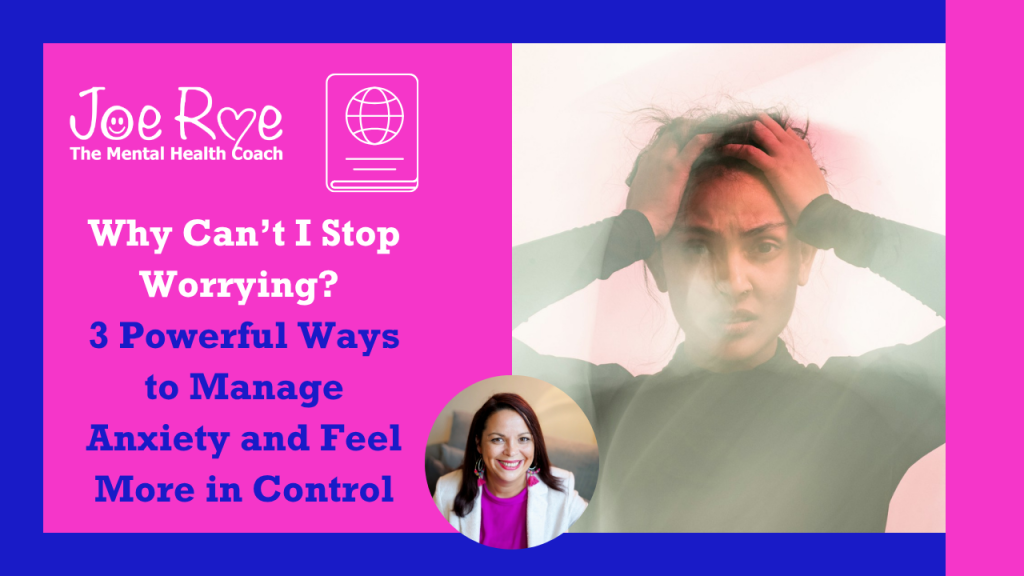
“Why can’t I stop worrying?”
It is a question many people quietly type into Google when their thoughts will not slow down. Perhaps your mind continually jumps to everything that could go wrong. You replay conversations, question your decisions or prepare for situations that have not even happened. You might feel unable to relax, even when there is no immediate problem to solve.
At night, your body may be exhausted while your mind remains wide awake. You tell yourself to stop worrying, but the thoughts keep returning.
Sound familiar, folks?
You are not weak, failing or “too sensitive.” Anxiety can place your mind and body into a heightened state of alert, making ordinary uncertainties feel urgent, threatening and impossible to ignore.
The reassuring news is that anxiety does not have to remain in the driver’s seat. With understanding, practical tools and the right support, you can begin to quieten the noise, respond differently to anxious thoughts and reconnect with your sense of control.
What is Anxiety?
Anxiety is the mind and body’s response to a perceived threat, risk or uncertainty. In genuinely dangerous situations, this response can help protect us. Your body prepares to react quickly by releasing stress hormones, increasing your heart rate and sharpening your awareness.
The difficulty arises when this internal alarm continues sounding even when you are not in immediate danger. Anxiety may be linked to:
- Work pressure or financial worries.
- Relationship difficulties.
- Health concerns.
- Trauma or distressing experiences.
- Major changes and uncertainty.
- Low confidence or self-esteem.
- Fear of failure or rejection.
- Feeling responsible for everybody else.
- Perfectionism and people-pleasing.
- A build-up of everyday stress.

Sometimes there is an obvious trigger. At other times, anxiety seems to appear without a clear explanation.
What Are the Common Symptoms of Anxiety?
Anxiety does not only affect your thoughts. It can be experienced emotionally, physically, and behaviourally.

Common anxiety symptoms may include:
- Constant worrying, overthinking, and racing thoughts.
- Feeling restless, tense or on edge.
- Difficulty concentrating and irritability.
- Feeling overwhelmed.
- A sense that something bad is about to happen.
- Trouble falling or staying asleep.
- A racing or pounding heart.
- Shaking, sweating or feeling hot.
- Tightness in the chest and shortness of breath.
- Headaches or muscle tension.
- Nausea or digestive problems.
- Avoiding people, places or situations.
- Frequently seeking reassurance.
Not everyone experiences anxiety in the same way. One person may struggle with intrusive thoughts, while another notices physical symptoms such as a racing heart, tense muscles or an unsettled stomach.
Why Can’t I Stop Worrying?
Worry can create the temporary feeling that you are preparing yourself for something. Your mind may believe:
- “If I think through every possibility, nothing will surprise me.”
- “If I keep checking, I will prevent something bad from happening.”
- “If I stop worrying, I might miss something important.”
- “Worrying proves that I care.”
- “I need certainty before I can relax.”
However, worrying is not always the same as problem-solving. Problem-solving identifies an issue and moves towards a practical action. Anxiety often circles the same uncertainty without reaching a conclusion.
The more attention you give a worrying thought, the more important and threatening it can begin to feel. You may then check, avoid, over-prepare or seek reassurance to reduce the anxiety.
That relief is usually temporary, so the worry returns and the cycle begins again. Trying to force yourself to “just stop thinking about it” can sometimes make the thought feel even louder. Instead of fighting every anxious thought, it can be more helpful to change how you respond to it.
How Can I Stop Worrying?
There is no magic switch that removes every anxious thought. The goal is not to guarantee that you will never worry again. Worry is part of being human. Instead, you can learn to recognise when worry is taking over, calm your nervous system, and decide whether the thought requires action or can be allowed to pass.
Here are three powerful techniques to try:
Tip 1: Separate Practical Problems From “What If?”
Worries
When anxiety strikes, ask yourself: “Is there a practical action I can take about this today?”
Some worries involve real problems that can be addressed. For example:
Worry: “I am concerned that I will miss a payment.”
Possible action: Check the payment date, review your account or contact the company.
Other worries are hypothetical:
- “What if everybody judges me?”
- “What if I make the wrong decision?”
- “What if something goes wrong next month?”
- “What if I never feel confident again?”
These thoughts seek certainty about a future you cannot fully control. Try dividing a page into two columns:
- What I can influence? Write down any realistic action you can take.
- What I cannot control right now? Acknowledge these worries without trying to solve the entire future.
You might gently tell yourself: “This is an anxious possibility, not a fact. I do not need to solve it at this moment.”
This distinction can help move your mind away from endless mental rehearsal and towards purposeful action.

Tip 2: Ground Yourself in What Is Happening Now
Anxiety frequently pulls your attention into an imagined future. Grounding brings you back into the present by helping your brain notice what is actually happening around you. Try the 5-4-3-2-1 grounding technique. Pause and identify:
- Five things you can see.
- Four things you can physically feel.
- Three things you can hear.
- Two things you can smell.
- One thing you can taste or one slow breath you can notice.
Do not rush through it. Pay attention to small details: the temperature of the air, the texture beneath your fingertips or a distant sound you had not noticed before.
You can also place both feet firmly on the floor and say:
“I am here. I am safe in this moment. I only need to manage this moment.”
Grounding does not necessarily remove the situation causing your anxiety. It can, however, help reduce the intensity of your immediate reaction so you are better able to decide what to do next.

Tip 3: Create a Daily Worry Appointment
When worries interrupt your day, trying to suppress them completely may not work. Instead, give them a boundary.
Choose a regular 10-to-15-minute period as your designated worry time. Avoid scheduling it immediately before bed. When a worry appears during the day:
- Write down a few words about it.
- Remind yourself that you will return to it during your worry appointment.
- Gently bring your attention back to your current activity.
During your worry time, read through the list. Ask:
- Is this still worrying me?
- Is it a real problem or a hypothetical fear?
- Is there one small action I can take?
- Am I trying to gain certainty that nobody could realistically have?
You may discover that some worries no longer feel urgent by the time you return to them. This practice is not about ignoring your feelings. It teaches your mind that every anxious thought does not require your immediate and undivided attention.
Searching for anxiety support in Nottinghamshire, anxiety coaching near me or help with overthinking can feel overwhelming when you are already struggling. At the MoJoe Lounge in Edwinstowe, Nottinghamshire, I provide a calm, welcoming and confidential space where you can pause, talk openly and begin reconnecting with yourself. Online coaching sessions are also available for people who prefer support from home.
As an experienced, award-winning mental health coach and Master NLP Practitioner, I support adults and teenagers who may be experiencing anxiety, stress, low confidence, uncertainty or difficult patterns of thinking. Together, we can explore what may be fuelling your anxiety, recognise unhelpful patterns and develop practical strategies suited to you.
My approach is not about telling you to “just think positively.” It is about helping you understand yourself more deeply, reconnect with your existing strengths and take manageable steps towards feeling calmer and more in control.
Important Information
Mental health coaching and NLP coaching are not substitutes for medical diagnosis, psychotherapy, psychiatric treatment or emergency mental health care. Joe Roe is not a medical doctor. Some physical health conditions can cause symptoms that resemble anxiety. Speak to your GP or another qualified healthcare professional if symptoms are new, severe, persistent or concerning. If you or somebody else is in immediate danger, call 999 or attend A&E. If you are experiencing a mental health crisis in Nottinghamshire, call NHS 111 and select option 2 to speak with a mental health professional.
